™byNature Based Toys
Exclusive product design for retailers and brands

Sensory resources designed for your shelves, and nobody else’s.

We are WooBeWee. For six years we have designed educational sensory toys, made them, sold them and stood behind them — 4,000 different designs of our own, and around 200,000 pieces through our own shop. We are not a file library and we are not a factory: we design a range that belongs to one partner, you print it close to your own customers, and nobody else can buy it.

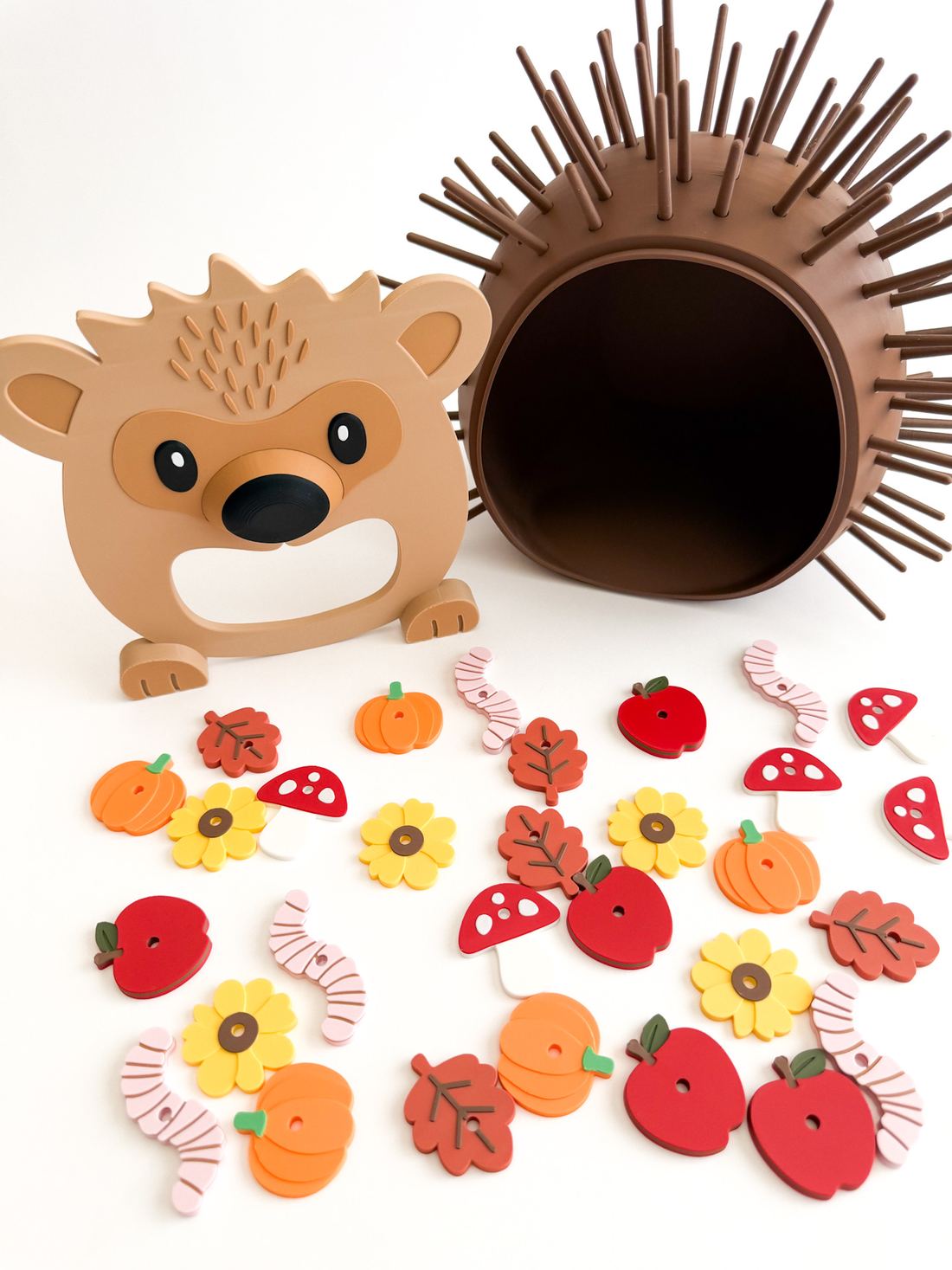
A WooBeWee hedgehog fine-motor set surrounded by printed autumn leaves, apples, pumpkins and mushrooms
Print · Play · Inspire
6 years

designing educational sensory toys, selling them and answering for them

4,000

different designs of our own — not one of them licensed out of a library

200,000

pieces sold through our own shop, naturebasedtoys.com

Exclusive

to your market, so your competitors cannot stock the same range

The arrangement, in one line

We design. You produce. You sell.

We create, engineer and test the product. You manufacture it locally and sell it to your customers.

No overseas inventory · No minimum production runs · No surprise costs

You bring

What you already have

Your market
Your customers
Your local production, or a partner who prints for you

We bring

The product itself

Product design
Engineering and prototyping
Test printing and testing
Print optimisation
Production-ready files
Colour choosing in your own shop
Personalisation tools for your customers
Ongoing design support

You get

A range of your own

Exclusive products
Local production
Flexible quantities
A range nobody else stocks
Products your competitors cannot buy

You already have the market and the customers. What is hard to come by is a range that is genuinely yours — and that is the part we do.

Where it is made

Designed by WooBeWee. Made close to your customers.

We develop and test the product here. You — or a print farm near you — make it where it is going to be sold. That is not a compromise to live with; it is what makes small numbers and quick changes possible at all.

Twenty today, two hundred next month

Print to what is selling rather than to what somebody ordered six months ago. There is no minimum to reach and no container to fill.

A Christmas colourway by Tuesday

A seasonal colour, another size, a second language on the labels — a change to the files rather than a new production run.

Nothing crosses an ocean

Finished stock never ships. What travels is a file, so there is no freight, no customs and no six weeks between deciding and selling.

And it grows the way printing grows: one more machine, or one more local partner — not one more purchase order.

Why a licence is the wrong shape

Why we would rather draw you something new

We are asked for a commercial licence most weeks, and we almost always say no — which turns out to be good news for whoever asked.

A file anyone can buy is a file everyone can buy. Ten shops with the same licence sell the same toy, and not one of them has anything the others do not. We would rather draw you something that is only on your shelves.

And our shop designs were not drawn for your shelves. They were drawn for one family and one printer at home. Printed and sold at scale they want different tolerances, different plates and different colour work — so the honest answer is to design for the job rather than resell a file.

Printers are inexpensive now; a design that is genuinely yours is the part that is still hard to come by. Anyone can buy a machine and a spool. What is difficult is an original, manufacturable product that people actually pick up — and that is the part we have spent six years learning.

A few of ours

This is the kind of thing we make

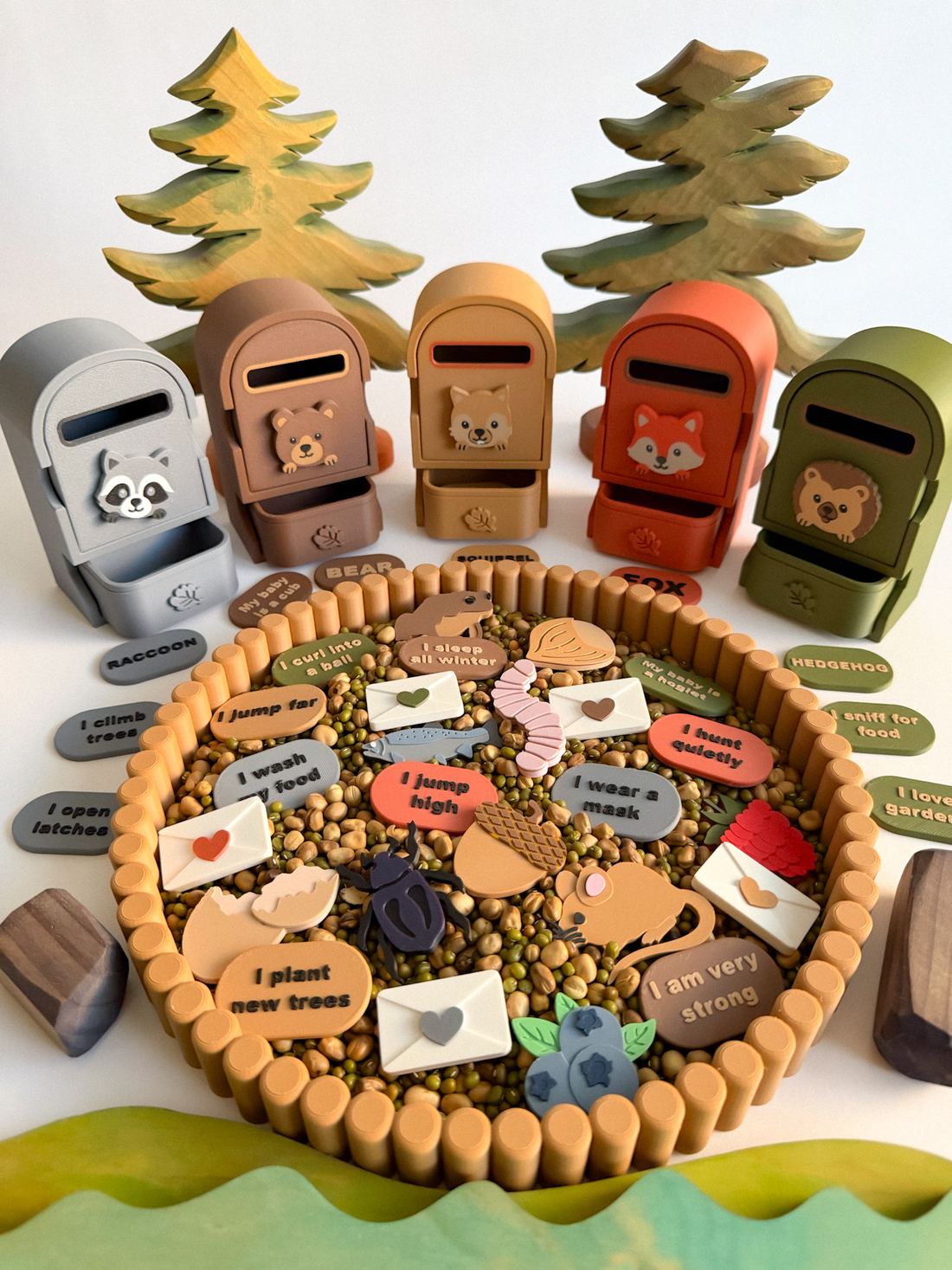
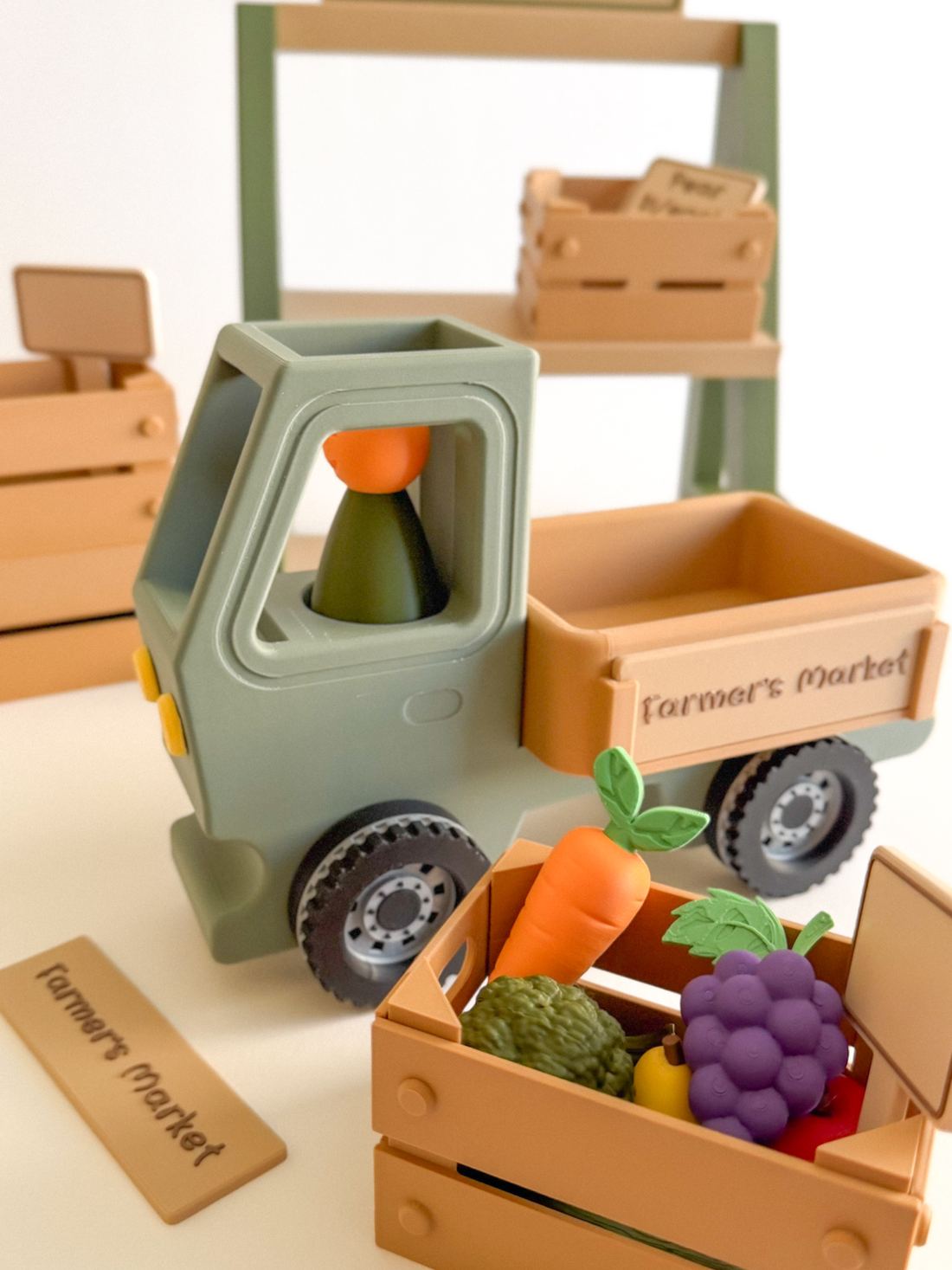
Every one of these is a WooBeWee™ design, drawn here and printed here before it ever went on sale. Yours would not look like any of them — that is rather the point — but it would be made with the same care.

Woodland post office set with animal mailboxes and a sensory tray of fact tokens
Woodland post officeSorting, reading and posting
Farmer's market play set with a truck, crates and produce
Farmer’s marketSmall-world and pretend play

There is a good deal more

The full range is in our shop — worth a look before you write to us, it makes the first conversation much easier.

Visit the shop
Three shapes it takes

Built around your business

Most projects turn out to be a mixture of these, and the first conversation is usually about working out which mixture.

Yours alone

A piece of your own

From a sketch, a photo, or just a sentence, to a finished toy — drawn, printed here, and adjusted until it comes off an ordinary desktop printer without a fight.

At volume

Personalised pieces

Names, letters, numbers, dates. A whole class or a whole alphabet gets written, sized and packed onto print plates in one go, so thirty pieces are one print, not thirty jobs.

Our method

Colour, ready to print

Multi-colour pieces that come off the bed finished — no painting, no gluing, no assembly. Open the file, load the spools we list for you, press print.

Sell personalisation

Personalised products, without drawing them one at a time

A name on a piece sells it — and drawing each one by hand does not scale past the first dozen. So we build the tool instead: your customer types or draws, and our software makes the production-ready file. You sell personalisation; nobody on your side opens a CAD program.

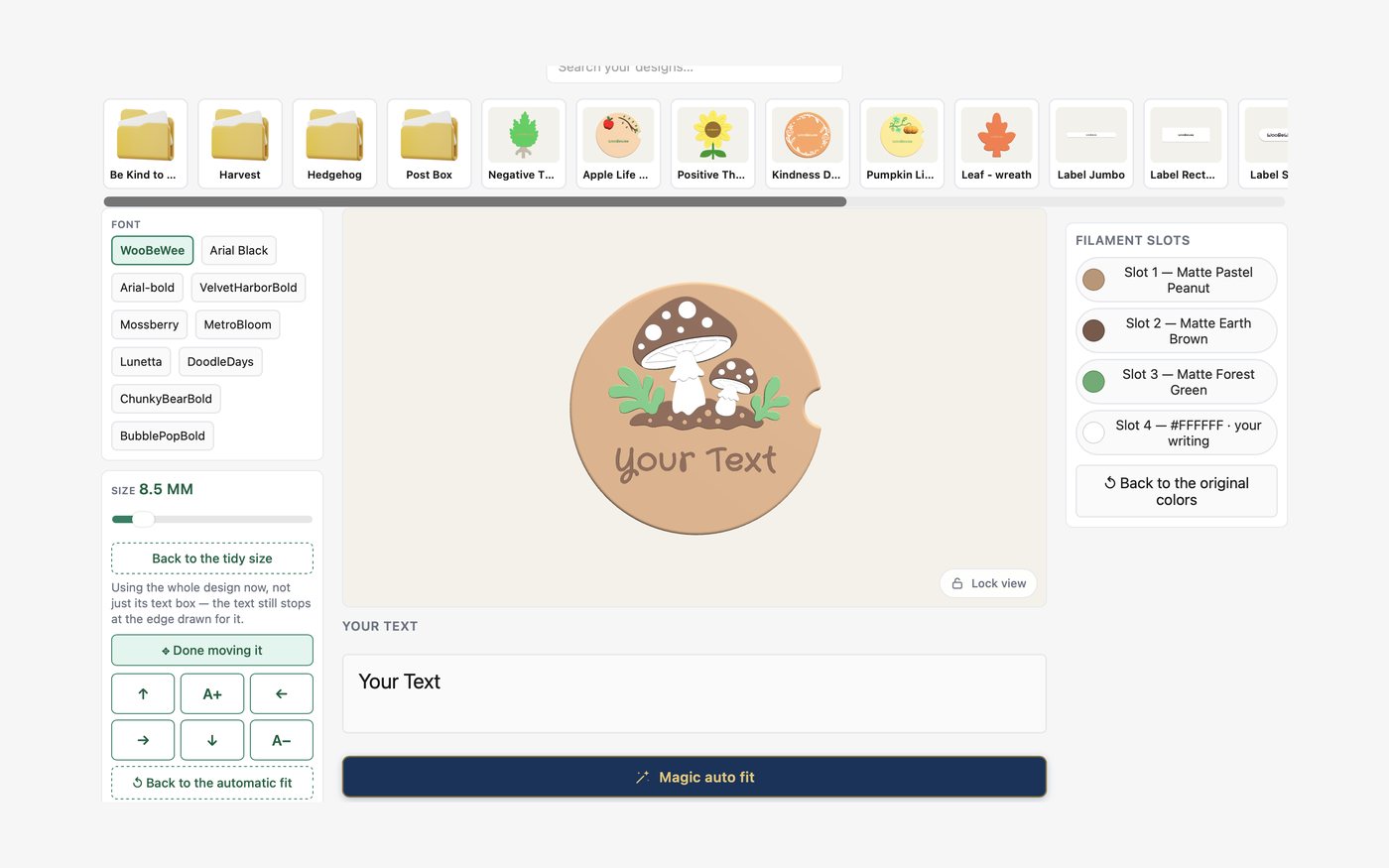
The Text Writer: a design library across the top, a mushroom coaster being lettered, and the filament slots beside it
Text Writer

Choose a design, type a name, and watch it sit on the piece before anything is printed. Ten fonts, a size that can be nudged a millimetre at a time, and a colour for every part — then it comes out as an STL or a Bambu Studio file, ready for the plate.

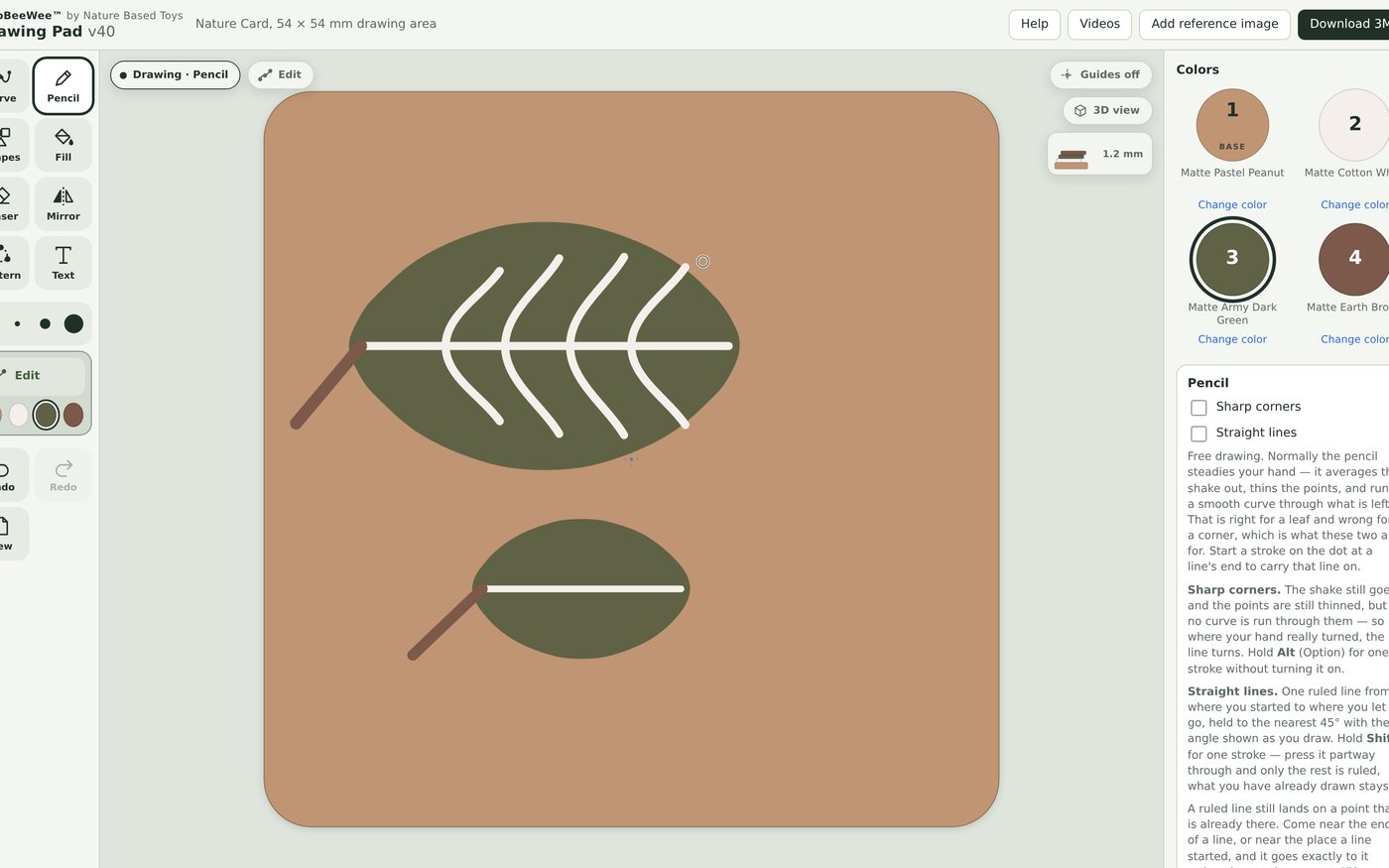
The Drawing Pad: a leaf drawn on a 54 mm nature card, with the pencil tools down the left and the colours on the right
Drawing Pad

A 54 × 54 mm card to draw on, by hand on a tablet or with a mouse. The pencil steadies the shake out of a line, a switch rules it straight to the nearest 45° instead, and whatever is drawn is raised off the card in the colours that were chosen for it.

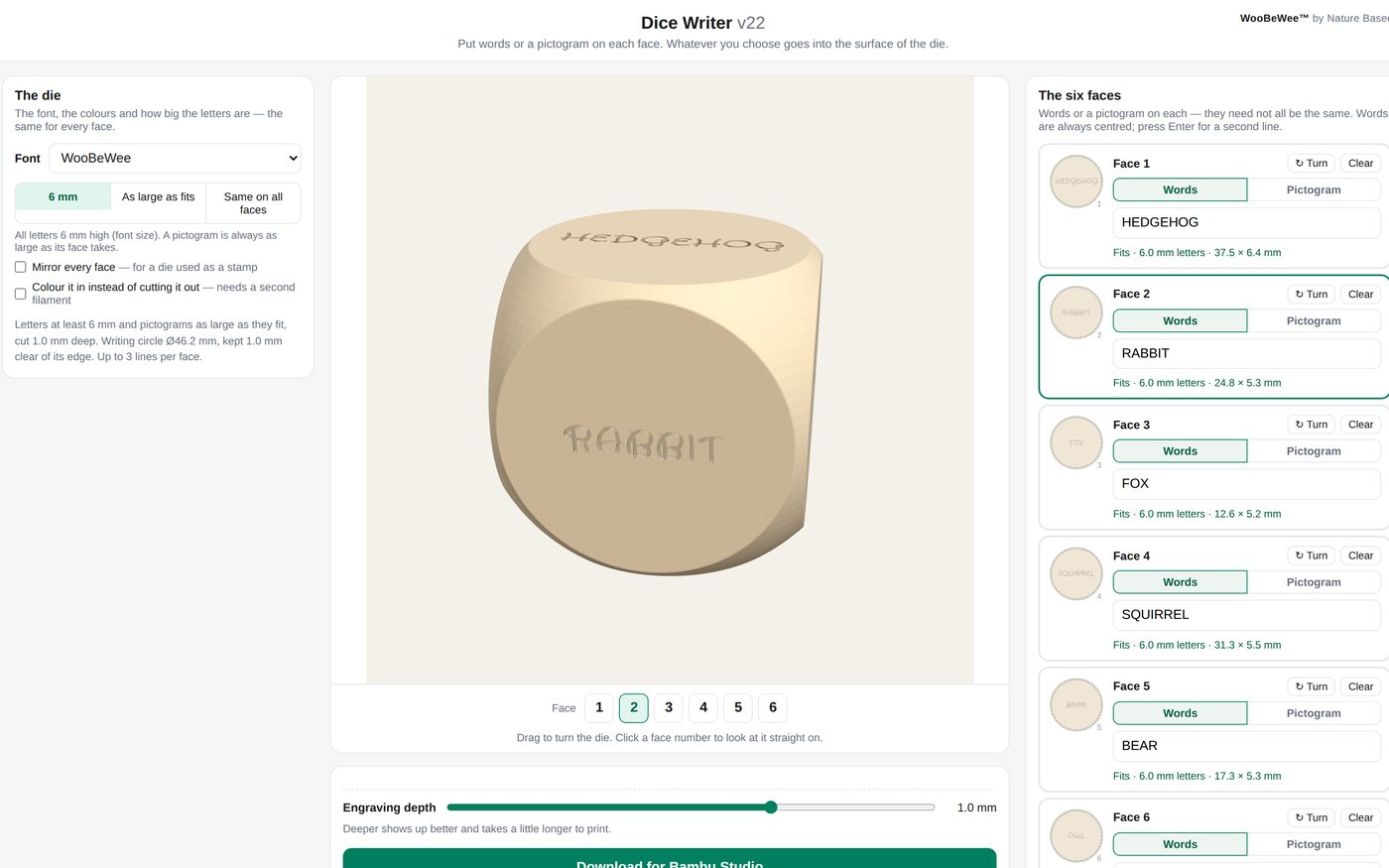
The Dice Editor: a six-sided die turning in 3D with a word cut into each face
Dice Editor

Six, seven, ten or twelve faces, with a word or a picture cut into each one. The die turns in 3D while it is being written, so nothing is a surprise when it comes off the printer, and how deep the letters are cut is a slider.

They run in a browser on a phone and a tablet as readily as on a laptop, they are ours, and they can be fitted to a range we design for you — so a personalised line is something you can offer without hiring a designer to service it.

Chosen by the customer

Our own colour system, from the shelf to the order

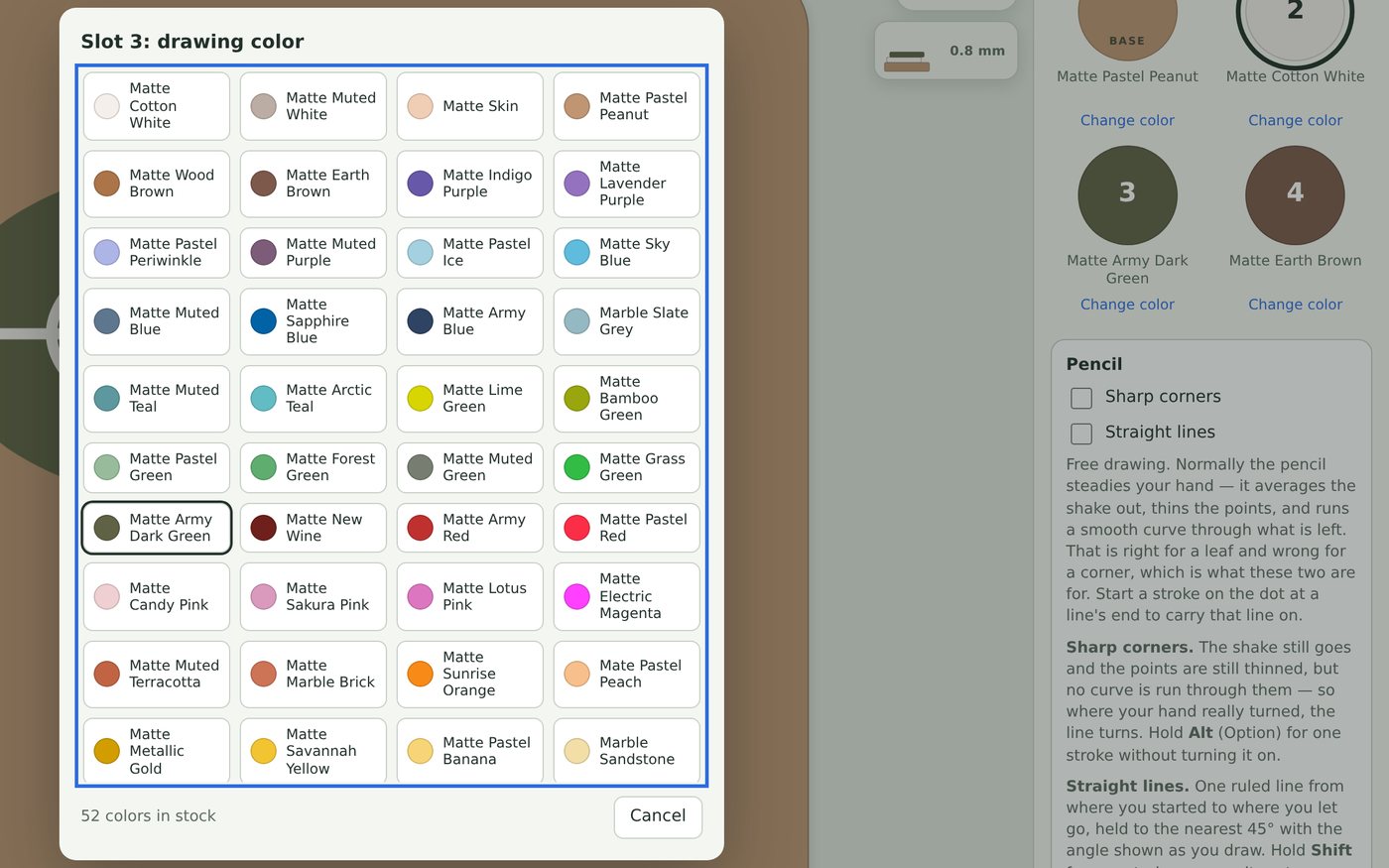
The colours in the tools are not a guess at what some printer somewhere might have. They are the filaments actually on the shelf — ours in our shop, yours in a collaboration — and a colour that has run out leaves the list the same day.

The colour chooser open on a drawing, showing the shop's filament palette by name

A design built for it has colour slots rather than one fixed palette.

So the customer decides what each part of the piece will be — the card, the writing, the cut-out — and sees it in those colours while they choose, not afterwards.

The picture they end up with is the picture that travels with the order, so nobody at our end has to imagine four colour names. It is one list everywhere: the shop’s own admin, the three tools, and the colour picker at checkout all read from the same place.

A colour chooser, built into your product

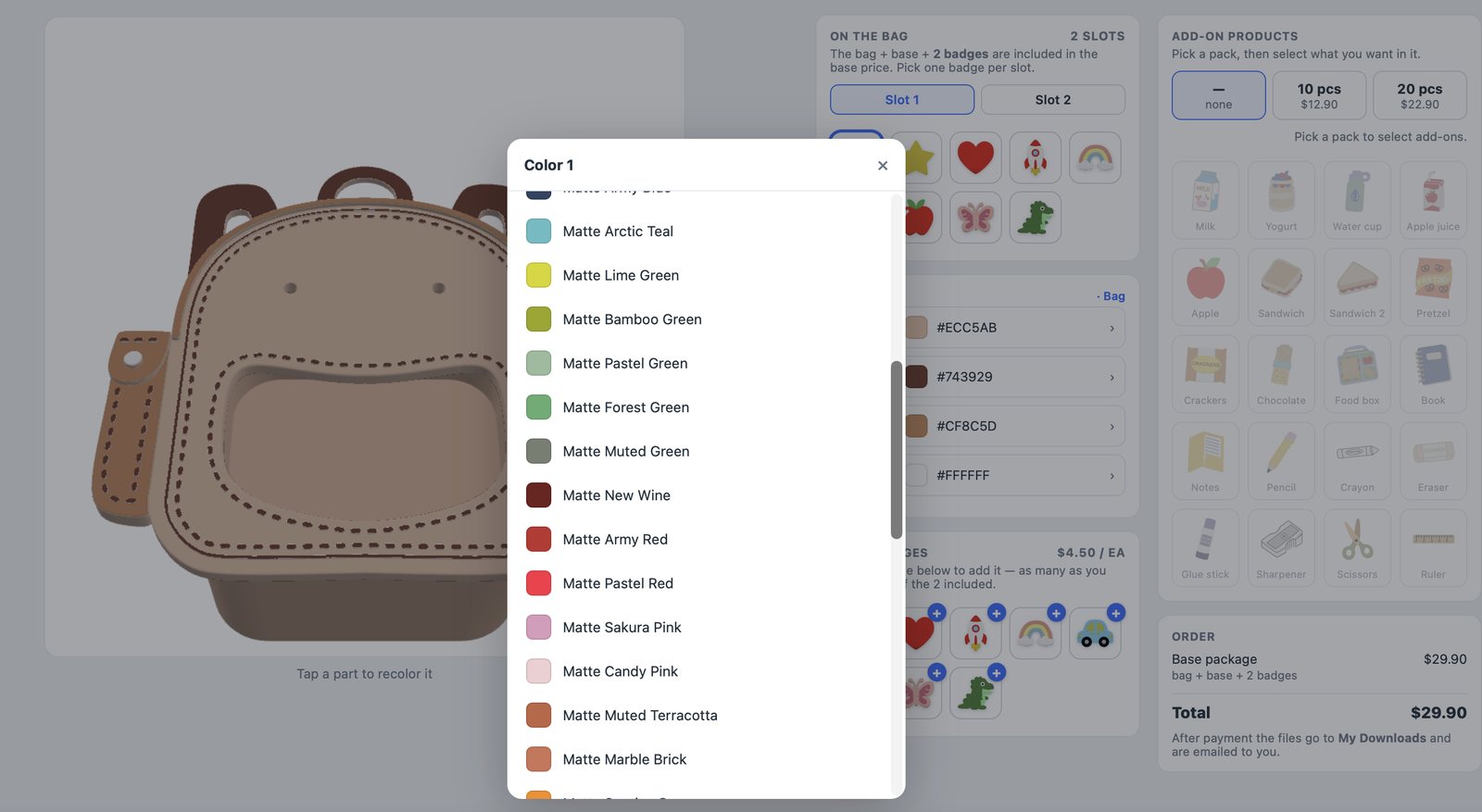
The same thing can sit on your own product page. We build it for the piece you sell: the customer gives each part its own colour, adds what goes with it, and watches the real thing change as they choose — so what they are looking at when they press buy is what they are buying.

Every colour in that list is a filament on a shelf. A customer cannot choose one that cannot be printed, and a spool that runs out leaves the list the same day — which is the difference between offering a colour and promising one.

And the order reaches you with the colours named rather than described: the exact filament for every part, beside the picture the customer was looking at. Nobody at the printer has to read “the brown one, a bit darker” and decide what it meant.

A lunch bag being put together on a product page: each part given its own colour from a named filament list, with badges, add-ons and the price beside it
A worked example

What a collaboration looks like

Nothing here is a promise about your project. It is one shape a project takes, so you can picture your own.

1
A children’s concept store asks for a woodland collection

Theirs alone, for their market, to sit beside what they already sell.

2
We design six coordinated products

Drawn here as a set rather than six separate things, with their shelf and their price in mind.

3
We prototype, print and test them

On ordinary desktop printers, until they come off the bed finished. You see photographs of the real pieces, and you ask for changes.

4
We hand over the production files

Project files, the filament map, the plate layouts — and a personalisation tool for the pieces that want a name on them.

5
A print partner near them makes the collection

Twenty to begin with. Two hundred when it moves. No container, no warehouse, no guessing a year ahead.

✓
They sell it exclusively — and it keeps growing

A Christmas colourway, a second size, two more pieces in the spring. The range keeps developing because the partnership does.

How it works

From your first message to files on your printer

1

Tell us

What the piece is, who it is for, and roughly how many you expect to sell in a year. A few sentences is plenty to start.

2

We send a quote

What it would take, what it costs, and how long. In writing, and nothing begins until you are happy with it.

3

Drawn and test printed

We print it here and send you photographs of the real thing. Changes at this stage are expected — please do ask for them.

4

Files in your hands

Print-ready project files, the filament map, and a written licence that says plainly what you may do with them.

Working together

Three ways to work together

Every partnership is different, so we agree on the model that makes the most sense for both sides before we begin.

One-time

A one-time partnership fee

A larger upfront fee covers the agreed design, development and commercial rights. Simple, predictable, and settled from the start.

Monthly

An ongoing monthly partnership

A fixed monthly fee gives you an ongoing relationship with WooBeWee — including the agreed exclusivity, continued development, new products, variations and support.

Revenue share

Grow together

Sales run through our system, and our share is calculated from the profit generated. No large upfront commitment — our success grows with yours.

Who we work with

Retailers, distributors and educational companies who want a range of their own

Toy and gift retailers Distributors and wholesalers Subscription boxes Museums and visitor centres Educational companies and schools Brands wanting a range of their own
Start a collection

Let’s create something your competitors don’t have

Tell us what you sell, who buys it, and what you wish you could put on the shelf. One of us reads every message and answers personally, usually within a couple of working days — and a rough idea is a perfectly good place to begin.

A picture, if you have one optional
A sketch, a photo, a screenshot — up to three, JPEG or PNG.

    We use what you write here to answer you, and for nothing else. No mailing list, no newsletter — just a reply from a person.